
The Mimar Sinan Mosque in Atasehir—a modern “selatin” on the Asian side of Istanbul
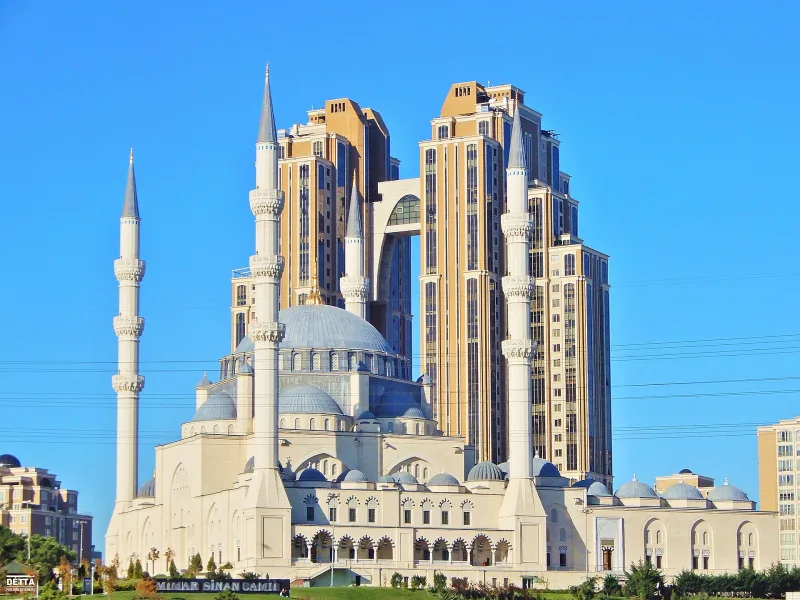
The Mimar Sinan Mosque is one of the most ambitious religious structures in modern Turkey and a striking landmark in the business district of Atasehir on the Asian side of Istanbul. Opened in 2012, the Mimar Sinan Mosque is named after the great 16th-century Ottoman architect, and its 42-meter-high central dome and slender 72-meter-high minarets are visible from afar among the glass towers of the business district. The complex is designed to accommodate 10,000–12,500 worshippers and was conceived as a “selatin”—a modern-day sultan’s mosque—intended, in the words of then-Prime Minister Recep Tayyip Erdoğan, to fill the gap left by the absence of an imperial structure of this scale on the Anatolian side of the city. This is a rare example of how the Ottoman architectural tradition is consciously carried forward into the 21st century.
History and Origins of the Mimar Sinan Mosque
The idea of a grand mosque for the rapidly growing Asian side of Istanbul had been discussed for years: by the early 2000s, more people lived on this side of the Bosphorus than in the historic European half, yet there were no major religious structures of “sultan-level” stature here. The project was commissioned by the Turkish government, and the architect was Hilmi Şenalp, known for his works in the spirit of the classical Ottoman tradition. Initially, the building was planned to be named the “Great Anatolian Mosque” (Ulu Anadolu Camisi), emphasizing its regional, unifying significance.
The name was changed during construction. By decision of Prime Minister Recep Tayyip Erdoğan, the mosque was dedicated to Mimar Sinan—the chief architect of Sultan Suleiman the Magnificent, the designer of the Süleymaniye, the Selimiye in Edirne, and dozens of other 16th-century masterpieces. Thus, through its name, the modern complex was linked to the golden age of Ottoman architecture, and at the same time to a figure whom Turkish cultural memory regards as a symbol of engineering genius and religious tolerance.
The grand opening took place in 2012 and was accompanied by a symbolic gesture, as if taken straight from the pages of Ottoman chronicles. At the ceremony, Erdogan presented miniature copies of the mosque to honored guests—in imitation of the ritual of the sultans, who, after the construction of a new selatyn mosque, would gift its scaled-down models to viziers and foreign ambassadors. In doing so, the organizers made a direct reference to the 16th century, when such buildings were not merely places of worship but political manifestos of the empire.
In his speech, Erdogan stated explicitly: prior to Mimar Sinan, there was no true “selatin”—a sultan’s imperial mosque—on the Anatolian shore of Istanbul. This term refers to a special status: selatin mosques were built only at the behest of the ruling sultan, such as the Süleymaniye or the Blue Mosque. The modern structure has received the same typological designation—a rare instance where 21st-century architecture is consciously integrated into the old sacred hierarchy.
The name of the great Sinan was not chosen by chance. The Janissary architect, who lived nearly a century and outlived three sultans, left behind hundreds of mosques, bridges, bathhouses, and madrasas throughout the empire—from Damascus to Budapest. For the Russian-speaking reader, Sinan’s name is comparable in significance to figures like Rastrelli or Bazhenov in our culture: he is not merely a builder, but an architect-symbol through whom the state has spoken the language of grand architecture for centuries. By naming the new mosque after him, the clients linked 2012 to the golden age of Ottoman architecture and, at the same time, demonstrated which tradition they wish to follow.
Architecture and What to See
Externally, the Mimar Sinan Mosque looks almost like a textbook example of classical Ottoman typology: a square prayer hall crowned by a central dome supported by half-domes and a system of buttresses. Hilmi Şenalp clearly drew on the language of the 16th century, but realized it using modern engineering—with a reinforced concrete frame hidden inside a stone shell.
The Central Dome and Minarets
The dominant feature of the complex is the 42-meter-high central dome. This height is intentionally close to the dimensions of historic sultan’s mosques so that the new mosque is perceived by the viewer as part of the same series. The two minarets rise 72 meters, defining the building’s silhouette against the backdrop of Atasehir’s skyscrapers. Externally, the walls are clad in light-colored stone, and the rhythm of the windows beneath the cornice and the arcades echo the proportions characteristic of the Sinan school.
Prayer hall for 10,000–12,500 people
Inside, the Mimar Sinan Mosque can accommodate between 10,000 and 12,500 worshippers at once—a capacity comparable to that of Istanbul’s largest historic mosques. The spacious prayer hall is lit through windows at the base of the dome, and on a clear midday, sunlight casts a complex grid of shadows from the arches onto the carpet. The mihrab and minbar are designed in traditional styles, while the large circular “levas” with calligraphy around the perimeter clearly reference Hagia Sophia and the Süleymaniye Mosque.
Underground complex: library, classrooms, and more
The most unusual part of the project is hidden from view—it is a vast underground space beneath the mosque and its courtyard. Inside are a library, classrooms, conference halls, retail spaces, a garage, and a VIP lounge. In essence, this is not just a mosque, but a cultural and educational center: worshippers come to pray, and on weekdays, lectures and exhibitions take place in the underground halls. This multi-layered approach is a continuation of the Ottoman concept of the “külliye,” where a mosque served as the heart of a neighborhood, complete with a madrasa, a bathhouse, a dining hall, and a hospital.
Courtyard and Exterior
In front of the mosque lies a spacious paved courtyard with a fountain for ablutions, surrounded by an arcade. From here, the main “postcard” view of the dome and minarets opens up, particularly striking at sunset when the stone glows in shades of pink. The courtyard also serves as a public square: on major holidays, worshippers fill both it and the surrounding area.
Dialogue with the Skyscrapers of Atasehir
A distinct artistic challenge of the project was to integrate this “classic” structure into a neighborhood that, until the early 2000s, looked like a dusty outskirts, but has now transformed into a dense forest of glass towers. The neighboring skyscrapers rise higher than the minarets, and the contrast between the cold glass and the warm stone is clearly visible, especially from the overpasses of the surrounding highways. The dome of the Mimar Sinan Mosque functions almost as a conceptual anchor in this setting: against the backdrop of corporate skyscrapers, it evokes a different timescale, one in which buildings endure for centuries. The architect deliberately avoided any “high-tech” elements on the façade—no glass, metal, or concrete on display. The entire exterior design emphasizes the recognizability of the Ottoman tradition, so that passersby do not have to wonder whether they are looking at a 16th- or 21st-century building.
Interesting Facts and Legends
- The mosque’s original project name was “Ulu Anadolu Camisi”—“The Great Anatolian Mosque”; Mimar Sinan’s name was added during the construction phase by a personal decision of Recep Tayyip Erdoğan.
- The mosque holds the status of “selatin”—a sultan’s imperial mosque—which is rare for the 21st century. Erdoğan emphasized that there had never been a structure of this kind on the Asian side of Istanbul until now.
- At the opening ceremony in 2012, foreign guests were presented with miniature models of the building—a deliberate imitation of an Ottoman court ritual in which sultans would present scaled-down copies of new selatin mosques to viziers and ambassadors.
- Architect Hilmi Şenalp specializes in the “Neo-Ottoman” style and, prior to Atasehir, had already worked on several large mosques in Turkey and abroad, consistently developing the language of Sinan’s school through the use of modern technologies.
- The underground level of the complex is comparable in size to the prayer hall itself: in addition to a library and lecture halls, a full-scale parking garage is planned beneath the mosque, a feature almost unheard of in Istanbul’s historic buildings.
How to get there
The Mimar Sinan Mosque is located in the Atasehir district, in the business heart of Istanbul’s Asian side, near the intersection of major highways. The most convenient way to get there from the European side of the city is by metro: the M4 line from Kadıköy goes to the Atatürk Mahallesi-İhsan Şenocak station, from where it is about a 10–15-minute walk to the mosque or one stop on a local bus. From the Taksim area, you can first go down to Kabataş, take the ferry to Kadıköy, and then transfer to the metro.
From Sabiha Gökçen Airport (SAW) to Ataşehir, it takes about 20–25 minutes by taxi or Havabus to Kadıköy with a transfer to the metro. From Istanbul Airport (IST), the journey takes longer: about an hour on the M11 metro, then crossing the Bosphorus and taking the M4 metro. Drivers have almost no parking issues—the complex’s underground garage has hundreds of spaces, which sets the mosque apart from the historic buildings of Sultanahmet. If you’re taking a taxi, just tell the driver “Atasehir, Mimar Sinan Camii”—apps like BiTaksi and iTaksi know the address. When using public transportation, it’s convenient to navigate using the İBB CepTrafik or Citymapper apps: they display real-time metro and bus schedules on the Asian side.
Tips for travelers
The best time to visit is spring (April–May) and fall (September–October): the sun is mild, and the mosque’s silhouette looks especially beautiful against a clear sky. In summer, Atasehir is hot and dusty due to business traffic, and in winter, the wind from the Sea of Marmara makes a walk through the courtyard quite chilly. Allow about 60–90 minutes for the tour: this is enough time to walk through the courtyard, stand in the prayer hall, and appreciate the proportions from the outside. If you happen to catch a public event in the underground library or conference hall, you’ll spend more time—but that’s a different scenario.
Visiting rules are standard for any active mosque in Turkey. Women must cover their heads, shoulders, and knees; free scarves are usually available at the entrance. Men should not wear shorts above the knee. Shoes must be removed before entering and left on a rack or carried in a bag. Try to visit outside of Friday noon prayers and the five daily prayers: during these times, tourist access is limited, and on major holidays, the mosque is entirely reserved for worshippers. Photography is allowed, but without a flash, and it is best not to point your camera at those praying.
If you’re traveling with children, this mosque is more family-friendly than many historic sites: there’s plenty of space inside, no crowds of tourists with guides, and the courtyard is perfect for a quick break. Bring water and a light snack—there are chain cafes in the business district nearby, as well as small lokanta eateries serving home-style Turkish cuisine. Architecture enthusiasts should bring binoculars or a good zoom lens: the fine details of the calligraphy under the dome and the carvings around the mihrab are only visible when zoomed in. A useful tip: download an offline map of Atasehir in advance; the signal in the metro underpass can be spotty, and the area’s landmarks aren’t as obvious as those in Sultanahmet.
For Russian-speaking travelers, it’s convenient to combine a visit here with a walk through Kadıköy and along the Marmara Sea waterfront: the area is quite different from the touristy Sultanahmet and offers a sense of “real” Istanbul without the postcard clichés. If you’ve already seen the Süleymaniye and Selimiye Mosques in Edirne, the Mimar Sinan Mosque will serve as a logical conclusion to a unique trilogy: a 16th-century classic, Sinan’s own late masterpiece, and its modern artistic replica, completed in the 21st century. This is a rare chance to witness a living Ottoman tradition unfolding right before your eyes.